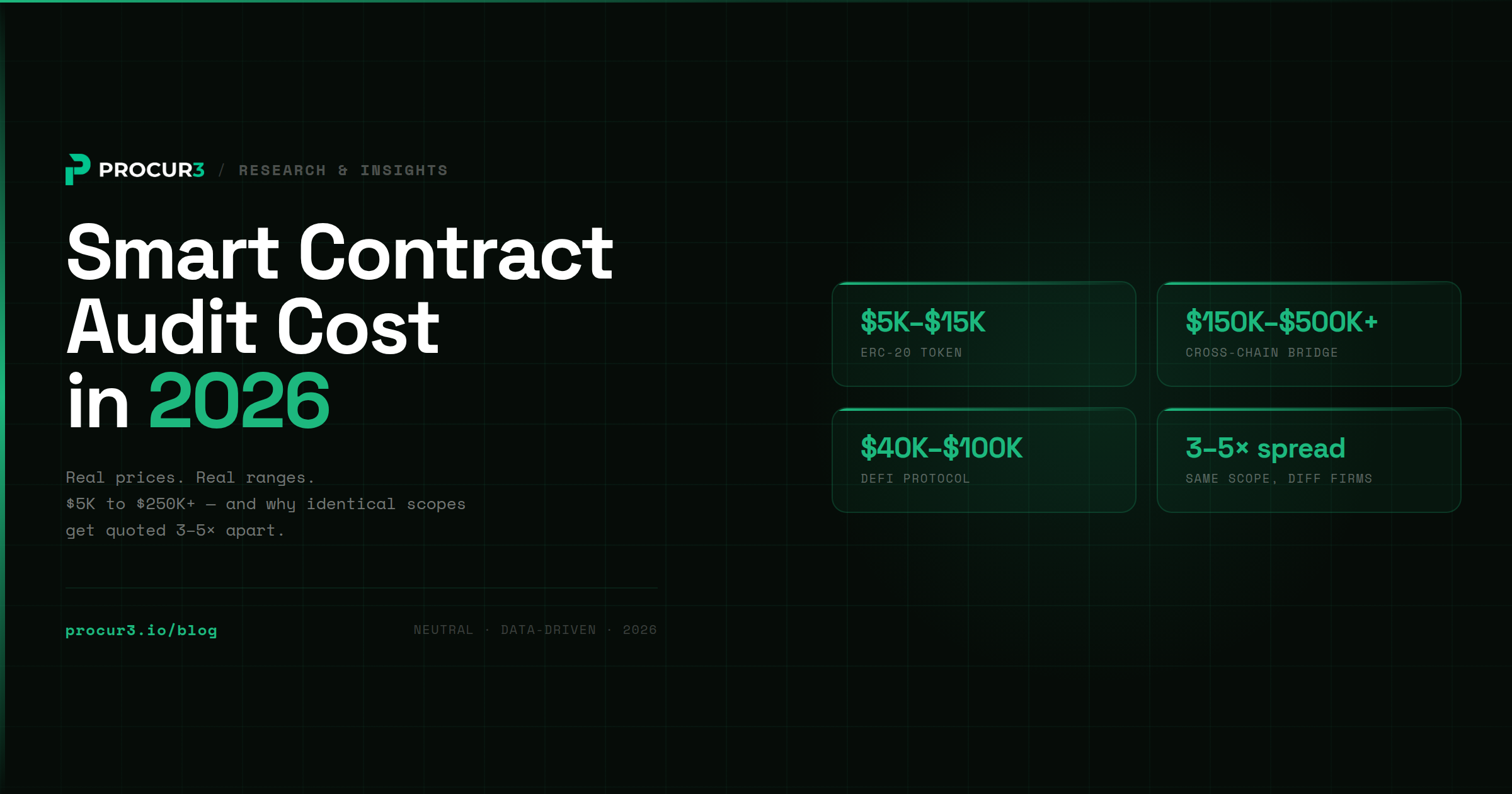
Quick answer: A smart contract audit costs between $1,000 and $250,000+ in 2026. A simple ERC-20 runs $1,000 to $10,000. A mid-complexity DeFi protocol runs $20,000 to $100,000. A cross-chain bridge runs $150,000 to $500,000+. But the number that matters more than any range is this: identical scopes, quoted by equally credible firms, routinely come back 3 to 5 times apart.
Procur3 is a neutral marketplace. We don't perform audits and we don't take a side on which firm you hire, so this guide reflects what quotes actually look like across the market rather than what any one firm wants you to believe about its own pricing.
Smart contract audit cost by protocol type (2026)
| Protocol type | Approx. nSLOC | Price range | Typical timeline |
|---|---|---|---|
| ERC-20 token (custom logic) | 200–500 | $1,000–$10,000 | 1–2 weeks |
| NFT collection (ERC-721/1155) | 500–1,500 | $3,000–$30,000 | 2–3 weeks |
| Staking / vault protocol | 1,000–3,000 | $5,000–$60,000 | 3–4 weeks |
| Lending protocol or AMM | 3,000–8,000 | $15,000–$150,000 | 4–8 weeks |
| Governance / DAO system | 1,000–5,000 | $10,000–$80,000 | 3–5 weeks |
| Cross-chain bridge | 5,000–15,000+ | $50,000–$500,000+ | 6–12 weeks |
| Audit contest (prize pool) | any | $10,000–$200,000+ | 1–4 weeks |
These are market ranges, not quotes. Two things are missing from almost every budget we see: the remediation review (a fix-verification pass, typically 10 to 20% of the base fee, and effectively mandatory), and the reality that a firm's quote moves with its current bench utilisation. A firm with an idle team next month quotes very differently from the same firm three weeks earlier.
What actually drives the price
Codebase size and complexity. Most firms price from normalised source lines (nSLOC), then apply a complexity multiplier. But raw line count is the weakest of the inputs. A 500-line contract with twelve external integrations, an upgradeable proxy pattern and custom math will cost more than a clean 2,000-line token. What genuinely moves the number is external dependencies, upgrade mechanisms, novel math, assembly, cross-chain messaging, and ultimately what you choose to put in scope.
Chain and programming language. This is the largest premium in the market, and it is a supply problem rather than a technical one. Solidity has the deepest auditor pool globally, which anchors base pricing. Rust-based Solana programs carry roughly a 25 to 40% premium. Cairo (Starknet) and Move (Sui, Aptos) sit around 30 to 45% above EVM equivalents. ZK circuit work, meaning circom, Halo2 and Plonky2, routinely runs 80 to 120% above the EVM baseline because the qualified reviewer pool is tiny. If you're on Solana, see our guide to the best Solana audit firms. For Aptos and Sui, see the Move audit firms guide.
Code readiness. The cheapest lever you control. A codebase with 90%+ test coverage, documented integrations, a written spec and NatSpec comments gets audited faster and cheaper, because reviewers spend their hours on logic rather than reverse-engineering intent. Teams that arrive prepared regularly see 20 to 30% off the same firm's quote for the same code.
Urgency. Compressed timelines add 20 to 40%. Flexible start dates earn discounts. Firms price scheduling friction directly, and they should.
Firm tier and brand. Top-tier firms charge 2 to 3 times mid-market rates for comparable scope. Some of that is depth. Some of it is the certificate itself, which carries real weight with exchanges during listing review and with investors during diligence. Whether that premium is worth paying depends entirely on your TVL and who you need to convince.
Want the number for your specific scope? The audit cost calculator takes five inputs and returns an indicative market range in about 30 seconds. No signup.
Why the same scope gets quoted 3 to 5 times apart
This is the part of the market almost nobody publishes. When a single scope is put to multiple qualified firms at once, the spread between the lowest and highest credible quote is routinely three to five times. On a single RFP, the average spread between the cheapest and most expensive bid is around $24,500.
The reason is simple: in an opaque market, sellers price-discriminate. Each firm quotes from its own utilisation, brand position, and appetite for your protocol category. Nothing forces those numbers to converge unless the buyer creates competition.
The defence is structural, not tactical. Put the same well-written scope to 5 to 10 matched firms simultaneously, with the same deadline, and compare the full package: price, named auditors, timeline, and whether the retest is included. That is the entire mechanism, and you can run it by email if you'd rather. Posting a scope on Procur3 just removes the admin.
Is an audit worth it? The blunt maths
The average loss per smart contract exploit over the past four years is approximately $1.9 million. H1 2026 alone recorded $1.31 billion in losses across 344 incidents.
Against that, a $70,000 audit on a mid-complexity DeFi protocol is not a large line item. But the more useful framing is exposure-based: estimate your peak TVL, apply a realistic exploit probability for an unreviewed protocol of your complexity, and compare the expected loss against the cost of review. For most protocols targeting meaningful TVL, that calculation is not close.
One caveat worth stating plainly: a cheap audit from a firm with no verifiable track record is not a saving, it's a purchased document. Compare firms on public audit history, findings by severity and post-audit incident record rather than on price alone.
Where teams waste audit budget
Auditing before the code is ready. Every architectural change after kickoff either invalidates findings or triggers a re-review. Stabilise first.
Skipping the remediation review. Fixes introduce bugs. A retest is typically included in the price, so use it.
Treating the audit as permanent. It covers one commit. Ship fourteen PRs and a new integration, and your audit describes code that no longer exists. Budget for diff reviews on material changes.
Buying one layer and calling it a security programme. H1 2026's losses concentrated in key management, multisig governance and operational compromise rather than contract code. An audit doesn't cover your signing environment, your cloud infrastructure, or your CI/CD pipeline. Budget for those separately.
Budget guide for 2026
A realistic pre-launch budget for a mid-complexity DeFi protocol is $60,000 to $120,000, inclusive of the initial audit and one remediation pass. Add 30 to 120% for Rust, Cairo, Move or ZK stacks. Add 20 to 40% if you need it fast. Protocols with meaningful TVL typically run total annual security spend of $150,000 to $500,000 once contests, bounties and monitoring are included.
Whatever tier you're buying in, the highest-leverage action is the same: make firms compete for the same scope.
FAQ
How much does a smart contract audit cost in 2026? Between $1,000 and $250,000+ depending on complexity. Simple token contracts run $1,000 to $10,000, mid-complexity DeFi protocols $20,000 to $100,000, and cross-chain bridges or enterprise systems $150,000+. The cost calculator gives an indicative range for a specific scope.
How much does a Solana or Rust audit cost? Roughly 25 to 40% above the Solidity equivalent for the same scope, because the pool of qualified Rust reviewers is far smaller than the EVM pool.
How long does a smart contract audit take? Roughly 1 to 2 weeks for a small token, 3 to 4 weeks for a standard DeFi protocol, and 6 to 12 weeks for a bridge or large multi-chain system, plus remediation. Top firms also carry 4 to 12 week booking queues, though many boutique firms can start sooner.
Why do audit quotes vary so much for the same code? Because pricing reflects each firm's utilisation, brand position and category appetite, not a market rate. Quotes on identical scopes routinely land 3 to 5 times apart. Competitive quoting is the only reliable way to discover what your audit should actually cost.
Can I lower my audit cost? Three ways that reliably work: arrive with high test coverage and complete documentation (20 to 30% saving), stay flexible on your start date, and put your scope to several firms at once rather than negotiating blind against a single quote.
What's the cheapest way to get a smart contract audited? For a simple contract, a boutique firm or an audit contest will usually come in lowest. But the cheapest credible quote and the cheapest quote are rarely the same thing. A review from a firm with no verifiable track record produces a document, not security. Check public audit history and post-audit incident records before optimising on price.